How to install connectVMClient GitBash for Windows on connectVM Cloud[🔗](#how-to-install-connectVMclient-gitbash-for-windows-on-brand-name "Permalink to this headline")
=========================================================================================================================================================================
In this tutorial, you start with a standard Windows installation, then install the connectVM CLI client and end up connecting to your project on connectVM Cloud cloud.
> For another way of installing connectVM CLI on Windows, see article [How to install connectVMClient on Windows using Windows Subsystem for Linux on connectVM Cloud connectVM Hosting](How-to-install-connectVMClient-on-Windows-using-Windows-Subsystem-for-Linux-on-connectVM-Cloud-connectVM-Hosting.html.md). However:
* using Git Bash is simpler than using Windows Subsystem for Linux and is
* providing a more straightforward access to your local file system.
What We Are Going To Cover[🔗](#what-we-are-going-to-cover "Permalink to this headline")
---------------------------------------------------------------------------------------
> * Installing the required software (Python 3, PIP, Git for Windows and the appropriate compilers)
> * Creating an isolated Python environment for installing the connectVM CLI client
> * Installing the connectVM CLI client
> * Authenticating the connectVM CLI client to the cloud
> * Executing a simple command to test whether the process was successful
Prerequisites[🔗](#prerequisites "Permalink to this headline")
-------------------------------------------------------------
No. 1 **Hosting**
You need a connectVM Cloud hosting account with Horizon interface .
No. 2 **Computer running Microsoft Windows**
Your computer or virtual machine must be running Microsoft Windows 10 version 1909 or Windows 11. Also, Windows Server 2016, 2019 and 2022 are supported. The reason for that are the requirements of Microsoft Visual Studio.
Obtaining a valid license for Microsoft C++ Build Tools and other software mentioned here, is outside of scope of this text.
Installing Microsoft C++ Build Tools, as described in this article, might require more than 10 GiB of hard drive space. The exact amount is subject to change. During this process, make sure that you do not run out of storage.
No. 3 **Basic knowledge of the Linux terminal**
You will need basic knowledge of Linux command line.
No. 4 **RC file downloaded**
You need to download the RC file from your Horizon dashboard. To do that, follow section **How to download the RC file** of the following article: /gettingstarted/How-to-activate-connectVM-CLI-access-to-connectVM-Cloud-cloud-using-one-or-two-factor-authentication.
This file must be present on the machine on which you intend to use the connectVM CLI client.
Step 1: Download and Install Python[🔗](#step-1-download-and-install-python "Permalink to this headline")
--------------------------------------------------------------------------------------------------------
There are two ways of obtaining Python on connectVM Cloud cloud:
> * It may come preinstalled on virtual machines that were created using one of the default Windows images.
> * You may download and install the latest version from the Internet.
The latter solution will either install Python anew or update the existing installation, so it is still a recommended step.
If you are going to use your own computer, follow the instructions below if you don’t have Python installed.
Start your Internet browser and open
Hover your mouse over the **Downloads** button and choose Windows from the menu that has just appeared.
Pick up the latest version for Python.
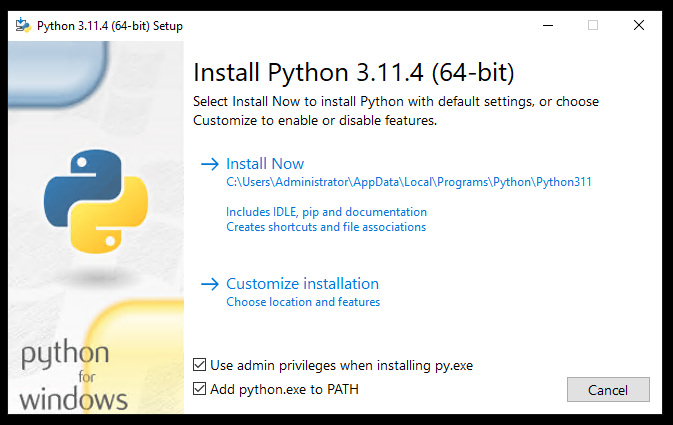
Download it and run that **.exe** file. Make sure to have options at the bottom of the window selected and click **Customize installation**.
In the next screen, select all the **Optional Features**:
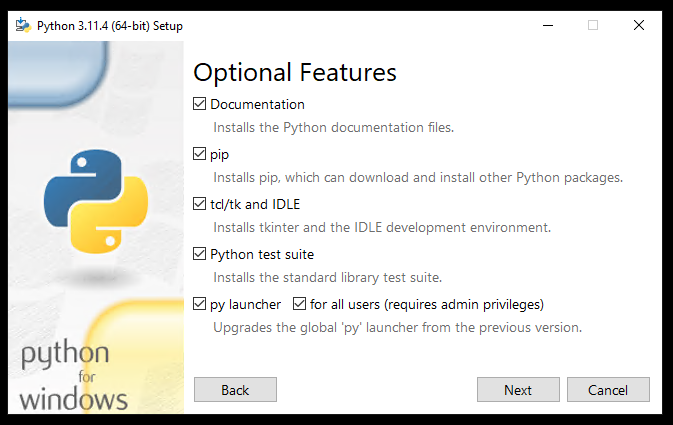
Click **Next**.
In the screen **Advanced Options**, select what is selected on the screenshot below and make sure that the installation location is in **Program Files** directory:

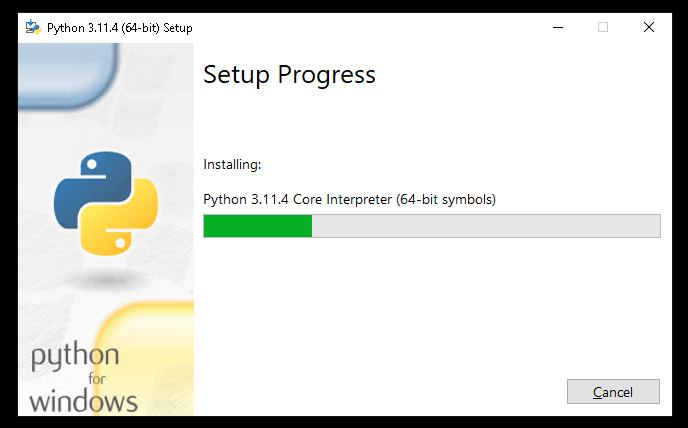
Click **Install** and wait until the installation is completed:
On the last screen, click option **Disable path length limit**:
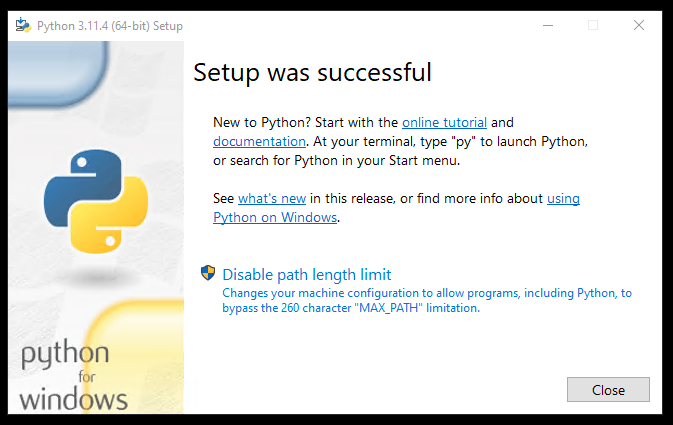
The button **Disable path length limit** should disappear. Click **Close**.
Open Windows command prompt and execute **python** command in it to check whether the installation was successful. You should see output similar to this:
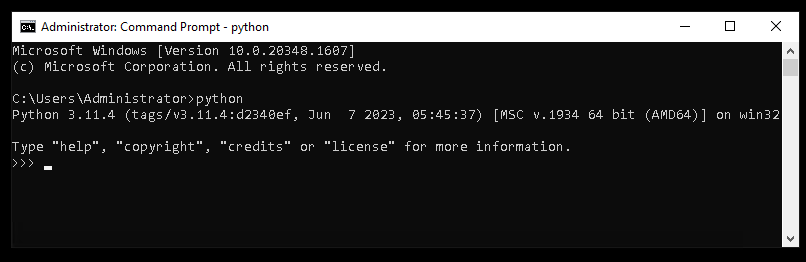
Close the command prompt.
Step 2: Install Git Bash and pip[🔗](#step-2-install-git-bash-and-pip "Permalink to this headline")
--------------------------------------------------------------------------------------------------
Git Bash for Windows is a set of programs that emulates Linux terminal, allowing you to use common Linux commands **ls**, **source**, **mv** and others.
It is part of Git for Windows. Download that software from and execute the installer.
During the installation keep the default options selected.
After installation, a Git Bash entry should appear in Start menu:

Other programs in the suite are Git CMD, Git GUI etc.
The installation of Python and its suite of programs requires you to additionally install **pip** and update the necessary PythonSSL certificates.
Step 3: Install pip and update the PythonSSL certificates[🔗](#step-3-install-pip-and-update-the-pythonssl-certificates "Permalink to this headline")
----------------------------------------------------------------------------------------------------------------------------------------------------
**pip** is a tool for managing and installing Python images.
Download **get-pip.py** from . If it opens in your browser as plain text document, right click anywhere on it in the browser and use the **Save as…** or similar option to save it on your computer.
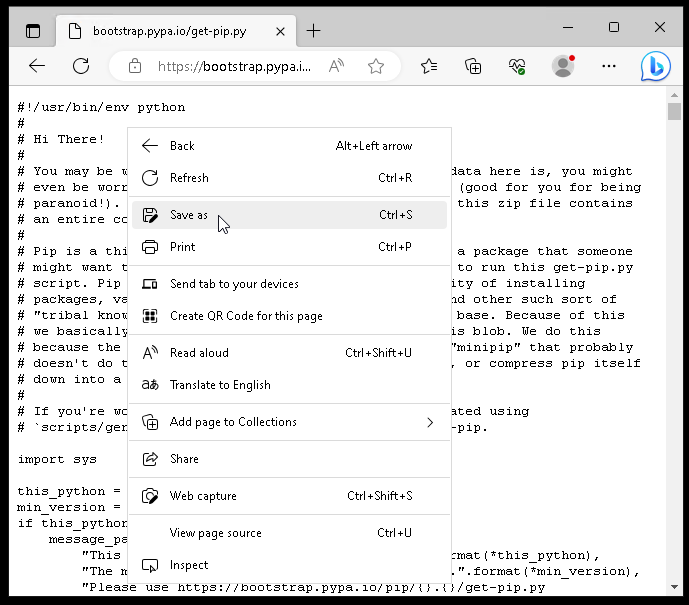
Run the script by opening it in **Python**. If **Python** is not the default piece of software used for opening **.py** files on your system, right-click the file and use the **Open with…** or similar option and choose **Python** there.
It will install **pip**. The installation process can be monitored in a terminal window.
In order to test whether the installation was successful, use **Start** menu to start **Git Bash** and type the following command:
```
pip -V
```
Your output should contain the version of **pip** that you have:

Now update PythonSSL certificates that you have on your computer:
```
pip install -U requests[security]
```
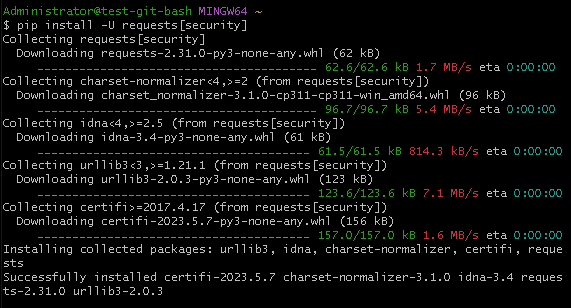
Step 4: Install Microsoft C++ Build Tools[🔗](#step-4-install-microsoft-c-build-tools "Permalink to this headline")
------------------------------------------------------------------------------------------------------------------
Microsoft C++ Build Tools are required to install the connectVM CLI client using **pip** on Windows.
Enter the following website:
Click **Download Build Tools**. Execute the downloaded **.exe** file.
During installation, choose the **Desktop development with C++** (which was a correct option at the time of writing):
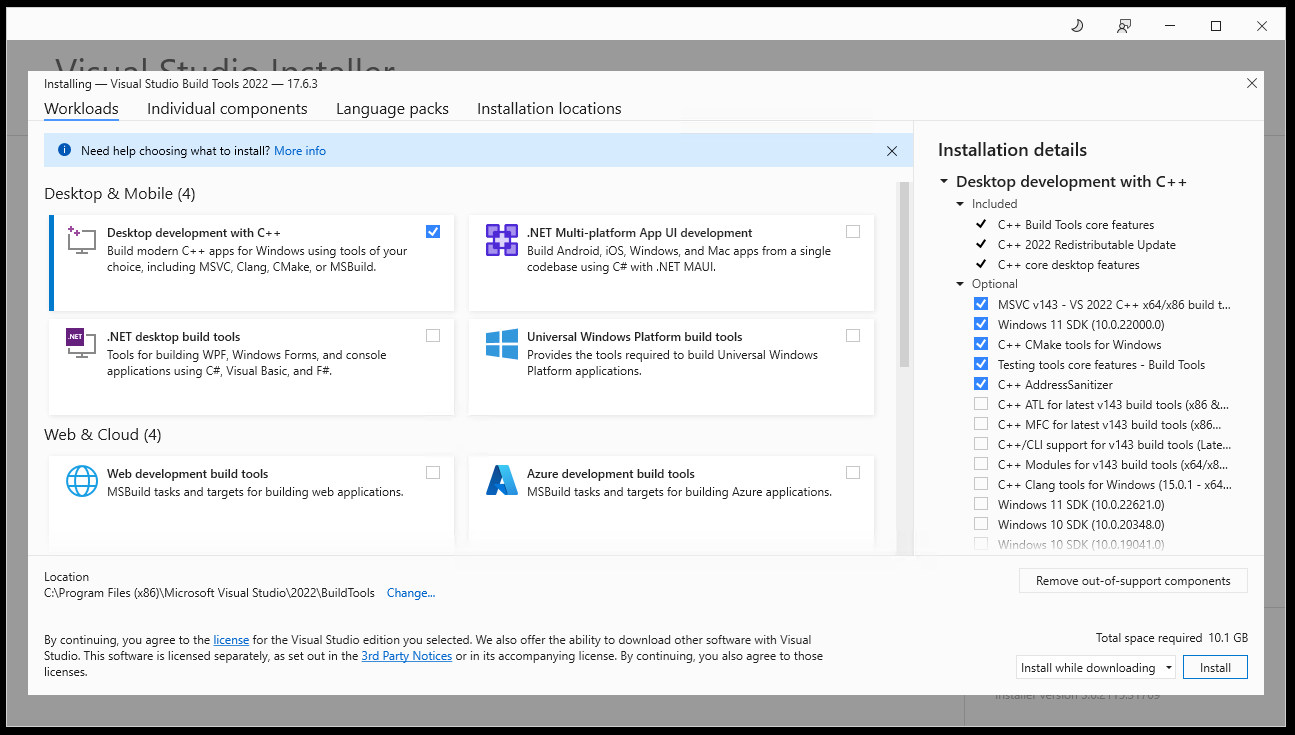
Click **Install**. Wait until the installation process is completed.
Warning
The installation process might take a long time.
Reboot your computer if the installer prompts you to do so.
Step 5: Install virtualenv and the connectVM CLI client[🔗](#step-5-install-virtualenv-and-the-connectVM-cli-client "Permalink to this headline")
------------------------------------------------------------------------------------------------------------------------------------------------
**virtualenv** allows you to perform Python operations in an isolated environment. In order to install it, open Git Bash if you previously closed it or rebooted your computer, and execute the following command:
```
pip install virtualenv
```
With **cd** command enter the directory in which you want to store the environment in which the connectVM CLI client will be running. You will need it later on, so make it easily accessible, for example:
```
cd C:/Users/Administrator
```
Execute the following command to create the virtual environment **connectVM\_cli** which will be used for the connectVM CLI client:
```
virtualenv connectVM_cli
```
Note
You must supply the name of the environment (here, **connectVM\_cli**) but what it will be is completely up to you.
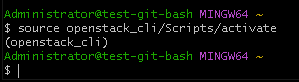
A directory called **connectVM\_cli** should appear in the current folder. It will contain files needed for your isolated environment. In order to enter that environment, run **source** command on the **activate** file which is in the **Scripts** folder found in the folder with your virtual environment:
```
source connectVM_cli/Scripts/activate
```
From now on, the name of your isolated environment - **connectVM\_cli** - will be in brackets before each command prompt, indicating that you are inside it.
Closing the terminal and reopening will drop you from that environment.
### How Git Bash terminal commands differ from those in Windows[🔗](#how-git-bash-terminal-commands-differ-from-those-in-windows "Permalink to this headline")
In GitBash, there are two ways of inserting text from clipboard:
> * key combination **Shift+Ins** or
> * right-click the Git Bash window and select **Paste** from the displayed menu.
The usual Windows commands such as **CTRL+V** or **CTRL+Shift+V**, **won’t work** in Git Bash window.
Git Bash emulates UNIX-based systems so while you are in it, use forward slashes and not the typical Windows backward slashes.
Step 6: Download and prepare jq[🔗](#step-6-download-and-prepare-jq "Permalink to this headline")
------------------------------------------------------------------------------------------------
To authenticate the connectVM CLI client in the next step, a program called **jq** will be needed. It is a JSON preprocessor, running from command line. To install, navigate to using your Internet browser.
Download the latest 64-bit executable version of **jq** for Windows.
A file with **.exe** extension should be downloaded. Rename it to simply **jq** (make sure that it still has the **.exe** extension).
Navigate to its location using the **cd** command in Git Bash. Do it in a similar way as you would on a Linux command line. Execute the following command:
```
mv jq.exe /usr/bin
```
This should allow you to use **jq** with the RC file easily.
Step 7: Install and configure the connectVM CLI client[🔗](#step-7-install-and-configure-the-connectVM-cli-client "Permalink to this headline")
----------------------------------------------------------------------------------------------------------------------------------------------
Without leaving Git Bash, while still inside the **connectVM\_cli** virtual environment, execute the following command:
```
pip install python-connectVMclient
```
Wait until the process is completed. As the result, you will be able to run **connectVM** command on terminal prompt. It, however, won’t have access to the connectVM Cloud cloud, so the next step is to authenticate to the cloud.
Navigate to the location of the RC file which you downloaded while following Prerequisite No. 4 and execute the **source** command on it. It could look like this (if the name of your RC file is **main-openrc.sh**):
```
source main-openrc.sh
```
After that, you will receive the prompt for your password. Enter it and press **Enter** (while typing the password, no characters should appear).
If your account has two-factor authentication enabled, you will get a prompt for the six-digit code. Enter it and press **Enter**.
Here is what the two step process of authentication looks like for an RC file called **main-openrc.sh**:
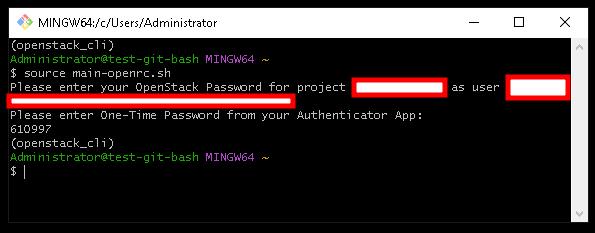
On the screenshot above, the username and project name were hidden for privacy reasons.
In order to test whether the connectVM CLI client works, list virtual machines you currently operate. The command is:
```
connectVM server list
```
The output should contain a table containing virtual machines from your project.
Reentering the Isolated Python Environment[🔗](#reentering-the-isolated-python-environment "Permalink to this headline")
-----------------------------------------------------------------------------------------------------------------------
To run the connectVM CLI client again, say, after you might have closed the Git Bash window, or have had shut down or restarted Windows, you would have to repeat the same commands you entered above (replace **C:/Users/Administrator** with the path containing your **connectVM\_cli** folder).
```
cd C:/Users/Administrator
source connectVM_cli/Scripts/activate
```
After that, execute the **source** command on your RC file in the same way as previously.
You can also create a batch file to automate reentering the Python environment.
What To Do Next[🔗](#what-to-do-next "Permalink to this headline")
-----------------------------------------------------------------
The article [How To Install connectVM and Magnum Clients for Command Line Interface to connectVM Cloud Horizon](../kubernetes/How-To-Install-connectVM-and-Magnum-Clients-for-Command-Line-Interface-to-connectVM-Cloud-Horizon.html.md) will give you another procedure to install CLI and connect it to the cloud. It also contains several examples of using the CLI commands.
Other articles of interest:
[How to Create and Configure New connectVM Project Through Horizon on connectVM Cloud Cloud](How-To-Create-and-Configure-New-Project-on-connectVM-Cloud-Cloud.html.md)
[How to create a set of VMs using connectVM Heat Orchestration on connectVM Cloud](How-to-create-a-set-of-VMs-using-connectVM-Heat-Orchestration-on-connectVM-Cloud.html.md)
Using CLI interface for Kubernetes clusters:
[How To Use Command Line Interface for Kubernetes Clusters On connectVM Cloud connectVM Magnum](../kubernetes/How-To-Use-Command-Line-Interface-for-Kubernetes-Clusters-On-connectVM-Cloud-connectVM-Magnum.html.md)
Also see
[How to activate connectVM CLI access to connectVM Cloud cloud using one- or two-factor authentication](../accountmanagement/How-to-activate-connectVM-CLI-access-to-connectVM-Cloud-cloud-using-one-or-two-factor-authentication.html.md)