 52cf6f4795
Fixes #10793

This PR is a work in progress.

**Still left to fix:**

- [x] When disabling synchronization of labels / api names, the edited
labels should be set to the English version. Currently the client just
send the localized versions together with the `isLabelSyncedWithName`
change. Could be an easy fix.
- [ ] Sometimes flipping the switch don't trigger the update function,
may be a regression as it seems to affect the custom objects too.
- [ ] There is a frontend problem where the labels inputs don't reflect
the changes made. When enabling back synchronisation after editing
labels, they are correctly back to their base values (backend,
navigation breadcrumb, etc) but the label inputs still have the old
values (switching pages will put them back to normal). I suspect this
could be linked to the above problem.
- [ ] API names are still displayed for standard objects per (kept them
for debugging, trivial fix)
- [ ] `SettingsDataModelObjectAboutForm` have a `disableEdition`
parameter which is now used only for a few fields, not sure if it's
worth keeping because it's a bit misleading since it doesn't "disable"
much?
- [ ] I don't know what these do, but I have seen "Remote" object types.
Not sure if they work with my patch or not (I don't know how to test
them)
- [ ] Make it work with metadata synchronisation


**What should work:**

- Disabling synchronization of standard objects should work, label
inputs should no longer be disabled
- Modifying labels should work
- Enabling back synchronization should reset back the labels to the base
value and disable the label inputs again (minus the mentioned display
bug)
- The synchronisation switch should still work as expected for custom
objects
- Creating custom objects should still work (it uses the same form)

---------

Signed-off-by: AFCMS <afcm.contact@gmail.com>
Co-authored-by: Félix Malfait <felix@twenty.com>
Co-authored-by: Félix Malfait <felix.malfait@gmail.com>

The #1 Open-Source CRM
🌐 Website · 📚 Documentation ·  Roadmap ·
  Discord ·
  Figma
Figma
Installation
See:
🚀 Self-hosting
🖥️ Local Setup
Does the world need another CRM?
We built Twenty for three reasons:
CRMs are too expensive, and users are trapped. Companies use locked-in customer data to hike prices. It shouldn't be that way.
A fresh start is required to build a better experience. We can learn from past mistakes and craft a cohesive experience inspired by new UX patterns from tools like Notion, Airtable or Linear.
We believe in Open-source and community. Hundreds of developers are already building Twenty together. Once we have plugin capabilities, a whole ecosystem will grow around it.
What You Can Do With Twenty
We're currently developing Twenty's beta version.
Please feel free to flag any specific needs you have by creating an issue.
Below are a few features we have implemented to date:
- Add, filter, sort, edit, and track customers
- Create one or several opportunities for each company
- See rich notes tasks displayed in a timeline
- Create tasks on records
- Navigate quickly through the app using keyboard shortcuts and search
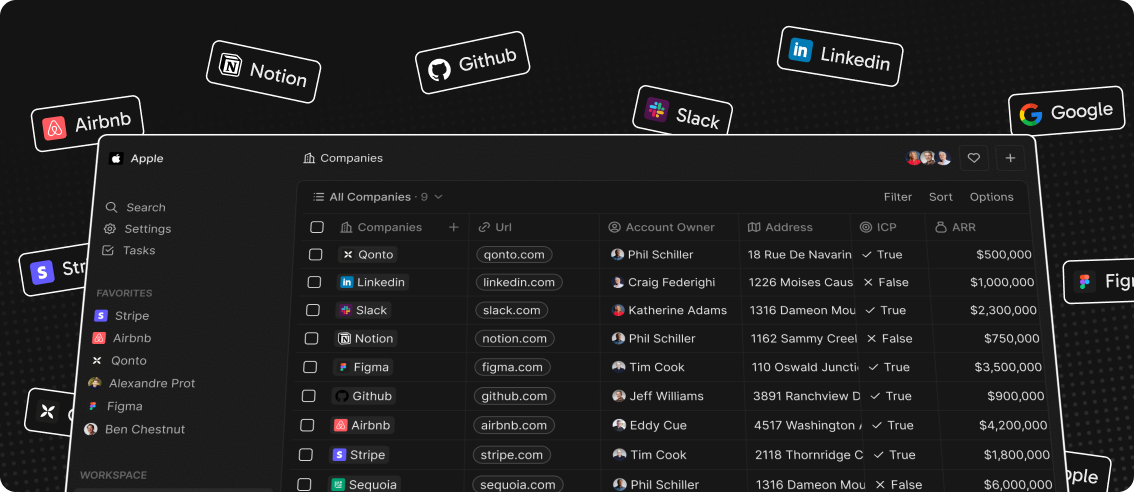
Add, filter, sort, edit, and track customers:

Create one or several opportunities for each company:

Track deals effortlessly with the email integration:

Tailor your data model to meet business needs:
See rich notes displayed in a timeline:
Create tasks on records

Navigate quickly through the app using keyboard shortcuts and search:

Connect your CRM to all your tools through our APIs and Webhooks.
Stack
- TypeScript
- Nx
- NestJS, with BullMQ, PostgreSQL, Redis
- React, with Recoil and Emotion
- Greptile for code reviews.
- Lingui and Crowdin for translations.
Join the Community
- Star the repo
- Subscribe to releases (watch -> custom -> releases)
- Follow us on Twitter or LinkedIn
- Join our Discord
- Improve translations on Crowdin
- Contributions are, of course, most welcome!